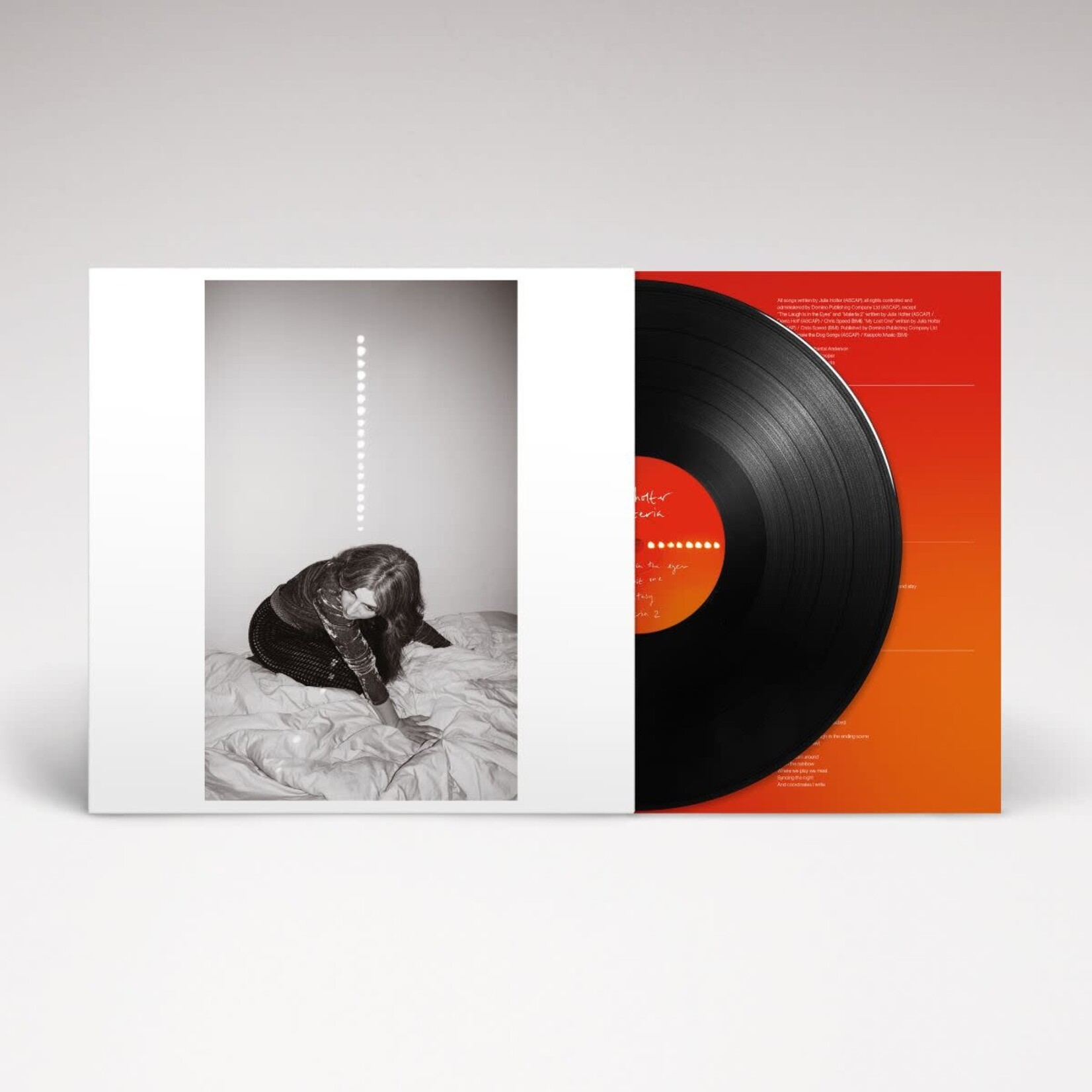
Julia Holter always knew there were multiple forms her song “Materia” could take. The tune’s dynamic, Hildegard von Bingen-inspired melody and dense modal chords stood on their own without a complex arrangement on her wondrous 2024 album Something in the Room She Moves, but she felt a lingering desire to expand the texture and stretch out the harmony. Though she could hear the potential orchestration in her head, Something was already abundant with layers of sound by the time she finished it. She stuck with the original form of “Materia,” then, her cresting voice and blue Wurlitzer hosting games of harmonic hide-and-seek above subtle electronics.
But on the new Materia, a kind of companion LP or sequel to Something, Holter has realized not one but two distinct versions of the song. “Materia 2” is a hallucinatory dream of drum machine, fretless bass, and clarinet, Holter’s voice spiraling through the ether alongside that of Jessika Kenney. She reconsiders the lyrics, too, novel fragments of surrealistic images reinforcing the original’s link between spirit and body, between love and blood. And on “Materia 3,” Holter literally slows down the take from Something. (It’s intended to be experienced as a “bonus track” in an homage to the CD era of her youth.) The change not only emphasizes the unpredictable glory of the harmonies within but also reiterates the song’s emotional sophistication, the sense that it’s about learning how to live.
Materia is only seven tracks long, but Holter works in nearly that many modes here. There is the slowed “Materia” and the version reimagined for two voices, of course, but there are also two tracks that spooled out of the DAW project files and full band she built for Something. There are two astounding improvisations: one where she manipulates her voice so that each word seems to contain a symphony and another that is one of Materia’s most spellbinding and emotional pieces, “My Twin,” from which Holter lifted a riff to build the song “Fantasy.” These seven songs show that Holter is among her generation’s most open writers of art-pop, moving among ideas and idioms with exploratory aplomb. Materia is a kind of playground for Holter, where each distinct scene steadily coheres into a moving whole.
Keen observers will recognize “The Laugh Is in the Eyes,” released as a single in 2024 as Holter toured Something. Indeed, the band from that record—Elizabeth Goodfellow (drums), Devra Hoff (fretless bass), Maia (flute), Chris Speed (saxophone and clarinet), Tashi Wada (synthesizers), and Kenny Gilmore (co-production, engineering, mixing)—reappears here, as does Holter’s sumptuous imagery: mountains in blue skies, bunches of wildflowers, flutes at play. “I need to learn to make the sweetness stay,” Holter sings over a fascinating rhythm that always seems on the verge of tumbling over itself. That romantic glow also courses through “Fantasy,” one of the most compulsive and engrossing songs Holter has ever recorded. For two minutes, she seems to stare from a window, daydreaming about all the goodness that can be. And in the chorus, she is ushered forward by Goodfellow’s drums taking over where the drum machine left, the rhythms and the textures bursting all around like summertime fireworks. But this dream that seems to arrive is yet framed by a grounding uncertainty: “Blink at the light and hope to survive.”
Though Holter has collaborated with many exceptional musicians in the last 15 years, solo work has always been key to her process, including unfettered improvisations where she builds melodies and harmonies in real time. Two of them are absolute highlights here. Taking its name from ancient water clocks, “Clepsydra” considers the absurdity of time, the way our need to quantify something that simply exists can make prisoners of us all. Aside from rewritten lyrics, it is heard here as she originally recorded it; the processed vocals reiterate how alien the concept of time can be and turn it into a sort of otherworldly love story. And though the 10-minute masterpiece “My Twin” was improvised by Holter alone, mostly in one take, it is a brilliant consideration of forking paths and multiplicity. Holter is in dialogue with another version of herself, considering the pleasure and pain into which we simply seem to stumble. Holter became a mother and lost a nephew while writing Something and many songs on Materia, and the imperialistic and violent behavior of her country have left her, along with so many others, shaken; this song is a reminder that gratitude is precarious but beautiful, and that presence is necessary.
There has always been a welcome fluidity to Holter’s work. On those earliest records, it was the way the sound seemed to bubble up from beneath a cloudy surface. On subsequent records, she would play with song forms, performing multiple versions on the same LP, as she has now done again across Something and Materia. And there’s the way her songs have always flowed into unexpected paths, curving left when you might have expected a straight line. Materia is the most compelling and concise expression yet of this fluidity—as a composer, as a singer, as a person who experiences, feels, and wonders. At one point, what became Something in the Room She Moves was titled Materia, a name Holter once worried might sound too serious; there was always something more to it, though, and here it is.
The Laugh Is in the Eyes
My Lost One
Fantasy
Materia 2
Clepsydra
My Twin
Materia 3